Google Ads adds channel prioritization and budget allocation, and your current Display setup expires in February
Two new optional controls replace all-or-nothing channel opt-outs, but accounts that don't reconfigure before February 2027 could see spend shift on its own.
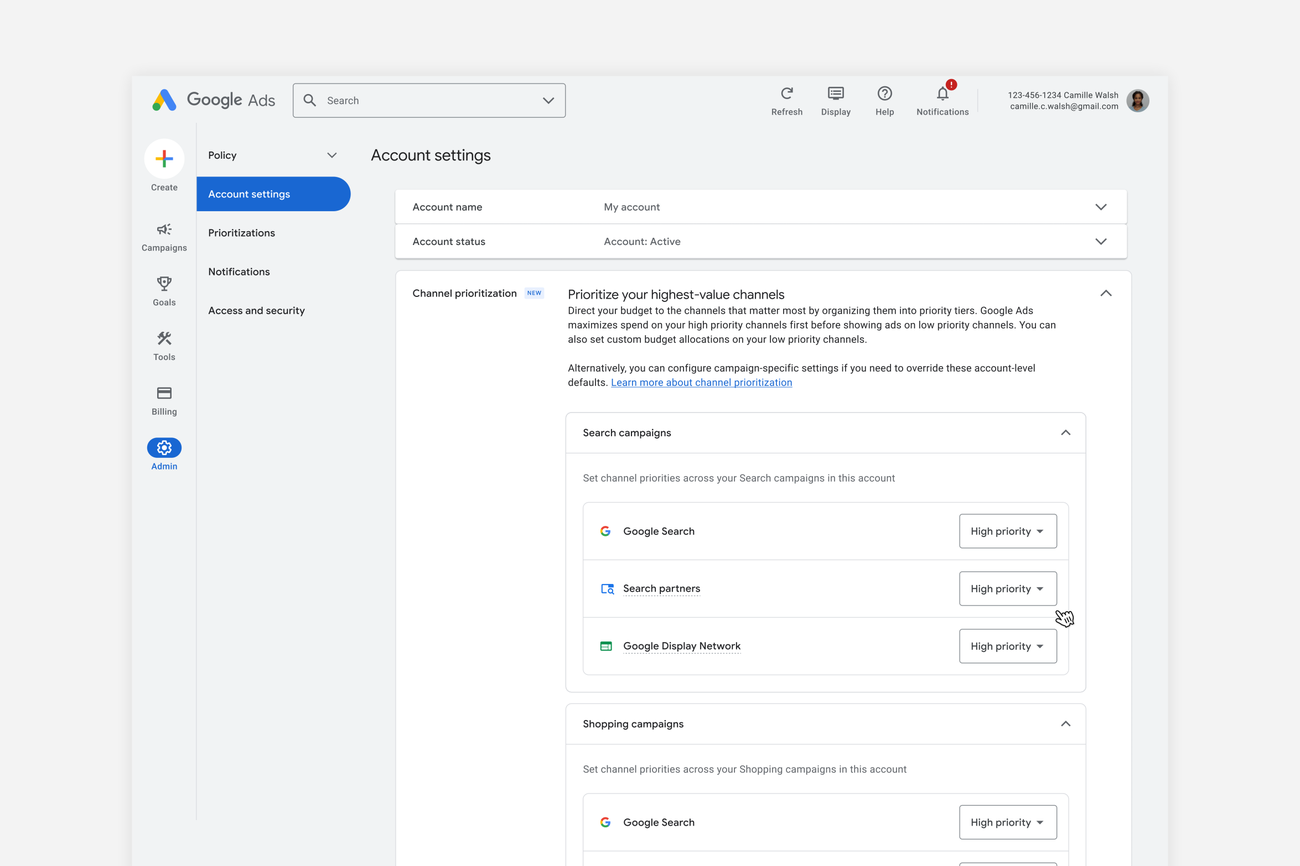
Google Ads is retiring its all-or-nothing channel opt-outs in favor of two new optional controls, channel prioritization and budget allocation, which Google announced on October 14. Advertisers can now rank ad networks as high or low priority and cap how much of a campaign's daily budget reaches the lower tier, instead of switching a channel off entirely.
For software companies running paid acquisition on Google, the new buttons matter less than what they replace. The setup that currently governs how Search campaigns split spend with the Google Display Network goes away in February 2027, and accounts that make no changes could see that split shift without anyone deciding it should.
What changed
Channel prioritization lets a marketer label a channel, or a group of channels, "High priority" or "Low priority" for a given campaign type. Google funds the high-priority tier first, within a campaign's Target CPA or Target ROAS goal where one is set, then routes whatever budget is left to the lower tier. On Search campaigns, that means Google Search, Search partners and the Display Network can each sit on their own tier. In Performance Max and Demand Gen, Google's own surfaces, including Search, YouTube, Maps, Gmail and Discover, are bundled together as "Google channels" and can't be prioritized individually. The controls apply at the account and campaign level, including shared budgets, across Search, Shopping, Performance Max and Demand Gen.
Budget allocation is the companion control. Once a channel is set to low priority, advertisers can cap the share of the daily budget it's allowed to spend, enforced on a best-effort basis rather than as a hard limit, with a 0% setting blocking the channel outright. Google framed the pair as a direct replacement for the binary choice marketers had before:
"Say goodbye to all-or-nothing channel targeting."
That line comes from Tal Akabas, Google Ads' director of product management, in the announcement. Google also said the change builds on earlier controls like Smart Bidding Exploration and campaign-level total budgets, part of a pattern of handing advertisers more granular levers over automated bidding rather than rolling them back.
The deadline behind the feature
The rollout starts now across all four campaign types, with limited Demand Gen testing beginning in November, according to Search Engine Journal. The forcing function is February 2027, when Google retires the current spend-allocation setup for Search campaigns that also run the Display Network. Every channel defaults to high priority under the new system, so an account that changes nothing could see its Display spend rise or fall without that being a deliberate choice. Advertisers who want to keep today's balance have to manually mark the Display Network "Low priority" and cap its allocation at 50% of the daily budget, the combination Google says reproduces current behavior. Search Engine Journal reported that a one-click migration option will be available at launch, and that Google plans to expand Search channel reporting by early 2027, with account-level allocation insights to follow after that.
What a software marketer should do
The effect on any given account depends on how it has been run. Teams that avoided Search partners or the Display Network entirely because they didn't trust the traffic quality now have a middle option: a capped test budget rather than a full opt-out. Teams that assumed their current Search-to-Display mix was stable need to check it before the deadline, because the setting that has been holding that mix in place is the one being removed.
Lead-gen-heavy SaaS accounts have more at stake in that drift than ecommerce advertisers chasing volume. Search partner and Display inventory tends to convert at a different quality bar than Google Search itself, and a demo request or trial signup that slips through on cheaper, lower-intent traffic shows up weeks later as a worse sales-accepted-lead rate, not as an obvious campaign problem. A marketer who hasn't opened the account settings before February may not connect a drop in pipeline quality back to a channel-mix change made months earlier.
Before locking in next year's acquisition budget, check whether your Search campaigns run with the Display Network turned on. If keeping the current split matters, mark Display "Low priority" and cap it at 50% of daily spend rather than leaving it on the default. If you've been fully opted out of Search partners or Display, consider testing a small, capped allocation instead of reversing the opt-out entirely, and watch actual spend closely since the cap is best-effort, not guaranteed.
Search Engine Journal's analysis of the launch, bylined to Brooke Osmundson, argued the budget-allocation lever is the more useful of the two for most advertisers, since accounts already hitting their CPA or ROAS targets have little reason to add restrictions that could narrow what Google's bidding system is allowed to do. The more practical use, in that reading, is testing inventory a team has avoided, not rebuilding campaigns that already work.
- Check whether live Search campaigns have the Display Network enabled before the February 2027 cutover
- Set Display to "Low priority" with a 50% allocation to hold the current mix, or let it default to high priority if a change is acceptable
- Treat the new budget caps as a way to test previously-avoided inventory, not as guaranteed spend ceilings
Google Ads has made channel-mix decisions largely invisible for years, folded into automated bidding that rewards marketers for trusting the system rather than second-guessing it. This update doesn't reverse that, but it does put a visible dial back on two settings that used to be all-or-nothing, and it attaches a real date to accounts that don't touch it.
 Search
Google is poisoning SERPs to stop scrapers, and rank trackers can't tell the difference
Sienna Mcpherson · 5 min read Distribution
Honeyjar launches an AI PR agent that pitches reporters, but says when you're not ready
Sienna Mcpherson · 5 min read Tools & Analytics