RevenueCat data shows annual SaaS trials converting best at 30 days, not 14
A 17,000-app RevenueCat benchmark ties trial length to conversion and renewal, and most B2B software teams are still defaulting to the 14-day trial the data argues against.
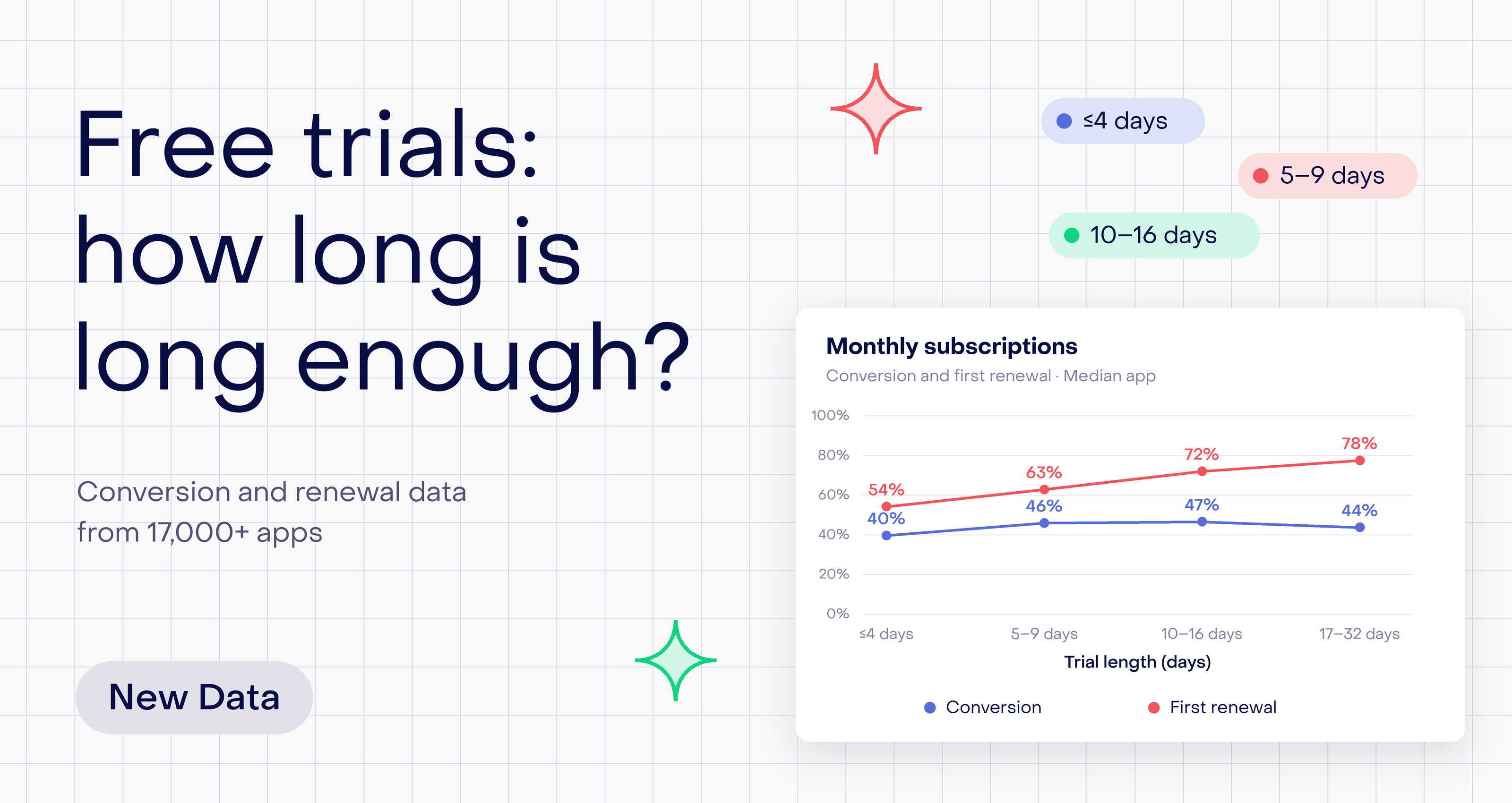
A benchmark of more than 17,000 subscription apps, published by RevenueCat on September 28, found that annual-plan free trials convert nearly twice as many buyers at 30 days as they do at four days or less — a result that cuts directly against the 14-day trial most B2B software companies still default to. SaaStr's Jason Lemkin flagged the finding to his audience the next day, noting that RevenueCat's dataset, which powers roughly 60% of mobile subscription billing, skews consumer but includes enough productivity and workflow apps to read across to B2B. SaaStr Fund was RevenueCat's first investor, back in 2018, so Lemkin's take is not neutral commentary — but the underlying numbers are RevenueCat's own, drawn from a year of trial starts on the App Store and Google Play.
What the data shows
RevenueCat split results by billing cycle — weekly, monthly and annual — and tracked both first conversion and first renewal. The annual numbers make the clearest case: buyers given four days or fewer to decide converted at 24%, and that figure rose in each longer bracket the report measured, topping out at 44.6% among buyers given 17 to 32 days. Renewal told an even sharper version of the same story, starting at 18.3% on the short end and reaching 47.5% on the long end. Combine the two — the fraction of buyers who were still paying customers a full year after their trial started — and the gap is the widest in the whole dataset: 3.5% versus 18.5%.
Monthly plans, which map more closely to self-serve B2B products, behave differently. Conversion peaks at 10 to 16 days (46.6%) and actually falls at 17 to 32 days (43.7%), even as renewal keeps climbing to 77.5%. RevenueCat also compared trial and no-trial buyers: monthly subscribers who skipped the trial renewed at 49.5%, well below the 77.5% renewal rate for those who sat through a 17-to-32-day trial. Annual no-trial buyers renewed at 26.6% — better than anyone on a trial shorter than 10 days, but still behind the 36.4% and 47.5% renewal rates on 10-16 and 17-32 day trials.
Why most B2B trials are still 14 days
Lemkin's explanation is the pattern most SaaStr readers will recognize on their own teams:
most of us run 14-day trials because Salesforce and HubSpot did it 15 years ago, and then push the annual plan hard on day 14
— Jason Lemkin, SaaStr
RevenueCat's own breakdown of the highest-volume apps backs that up outside B2B too. The company looked separately at whichever apps generated the most trial signups within each category and plan type, and found that nearly all of them default short anyway — weekly plans clustered at four days or under, monthly and annual plans mostly under nine. In other words, the apps generating the most trial volume are not the ones the conversion data would point to. RevenueCat's own writers are explicit that this shows what's common, not what performs best. There's a real caveat behind the longer-trial numbers too: someone who has stuck with a trial for most of a full month has, almost by definition, already shown more intent to buy than someone who quit within the first two days, so part of the longer-trial lift is self-selection rather than the extra days doing the work.
What to test first
For AI products the trade-off is sharper, because usage-based inference costs turn every extra trial day into a real marginal expense. On monthly AI subscriptions, first renewal improves from 57.4% to 64.2% between the five-to-nine and 10-to-16 day groups, but the 17-to-32 day group adds no further renewal gain while conversion drops to 31.8%. Annual AI subscriptions show the same upward pull at this stage — conversion rises from 23.3% to 33.8%, renewal from 19.6% to 29.4% — but RevenueCat doesn't publish a 17-to-32 day figure for annual AI apps, so it's unclear whether that gain keeps extending as far as it does without AI costs in the mix.
Geography changes the picture too, which matters for any software company selling outside North America. On monthly plans, conversion in the Middle East and Africa, India and Southeast Asia, and Latin America peaks in the five-to-nine day range and drops at 17 to 32 days — a 38.3% to 27.4% swing in the Middle East and Africa group alone. North America and Western Europe run the opposite way on annual plans, still gaining conversion at the longest trial lengths tested. A single global trial-length policy is likely wrong for at least one of your regions.
If you sell an annual plan and default to a 14-day trial, test lengthening it toward 30 days before treating that default as fixed — the conversion and renewal gap in this data is large enough to justify a real test, not just a policy memo. If you sell monthly self-serve, the current 14-day norm already sits close to where conversion peaks (10-16 days); a longer trial there trades some conversion for renewal, so choose based on which one is the bigger leak in your funnel today. For an AI product, treat the 16-day mark as a ceiling to test against rather than a starting point, and weigh any extension against your per-session inference cost.
What it doesn't tell you
RevenueCat's sample is drawn from mobile subscription apps — fitness, photo editing, streaming and games make up a large share of it — so the absolute percentages won't map one-to-one onto a desktop B2B SaaS funnel with sales-assisted deals. The report itself treats any group under 20 apps as directional only, and trials longer than 32 days were excluded from the conversion figures entirely. Read the specific numbers as a benchmark to test against, not a target to hit, and remember that the analysis making the B2B case for them comes from RevenueCat's largest investor.
 Positioning
Software has the shortest average CMO tenure of any industry, at 27 months
Sienna Mcpherson · 4 min read Pricing
Salesforce, HubSpot and Atlassian are now pricing AI agent access separately from seats, and the rates don't agree
Sienna Mcpherson · 4 min read Distribution